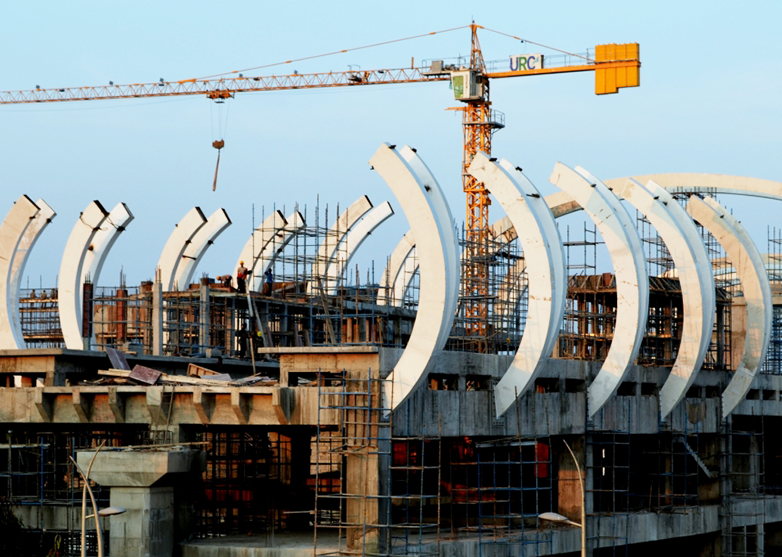
The Chennai Metro is an urban transport system in the city of Chennai, a large and fast-developing city in the south of India. The system comprises four lines, partly underground and partly elevated, and a total of 42 stations. Construction started in 2009, with the first line opening to the public in 2015. The total planned length of the system exceeds 45.1 km.
https://chennaimetrorail.org/project-brief/
Underground Stations
For this large construction project, Dextra was involved between 2011 and 2015 in the design, engineering, and supply of 61 FRP Soft Eyes for station entry/exit points as well as TBM insertion/extraction shafts.
Thanks to the properties of FRP material, Tunnel Boring Machines cut through the D-Wall in minimal time, saving time in the schedule and ensuring the perfect condition of the TBM’s head.
Elevated Segments
As a complement to Soft-Eyes for underground parts of the lines, Dextra also supplied Post-Tensioning Bar Systems for permanent applications.
The PT systems connect piles and precast segments of the elevated viaduct (shear key and hold-down applications). Each bar system, composed of high-tensile performance bars, plates, and nuts, is post-tensioned to provide seismic resistance.
For each of the 1,000 sets used on the Chennai Metro, Dextra also supplied the corrosion accessories necessary for this type of permanent application.
D-Walls
Finally, 350,000 Bartec couplers were also used vertically and horizontally in the station D-Walls.
Horizontal connections are performed with couplers left pending. Reconnection is done once the station is excavated, with second-phase rebar being reconnected to start the slabs.Finally, 350,000 Bartec couplers were also used vertically and horizontally in the station D-Walls.
Horizontal connections are performed with couplers left pending. Reconnection is done once the station is excavated, with second-phase rebar being reconnected to start the slabs.